
As AI adoption accelerates across manufacturing and automation, Nidec recognised the need to move beyond experimentation and build a shared, informed understanding of where AI can practically and safely create value, both internally and within future product offerings.
The Challenge
AI has moved from emerging technology to competitive necessity.
For Nidec's senior leadership team, the challenge was not whether to use AI, but:
- Where AI could deliver real commercial and operational value
- How to distinguish deployable AI from hype
- How competitors such as Siemens, ABB, and Schneider Electric are embedding AI at scale
- How to adopt AI within regulatory, ethical, and governance constraints
- How AI aligns with Nidec's existing evaluation frameworks and data assets
The leadership team needed a clear, shared mental model of AI, grounded in industrial reality, not generic technology narratives.
Our Approach
Enceladus delivered a senior leadership AI Awareness and Strategy Session, tailored specifically to industrial manufacturing and drive technologies.
Rather than focusing on tools or demos, the session was designed to:
- Build AI literacy at board and leadership level
- Provide strategic context for the 2025–26 AI inflection point
- Translate complex AI concepts into engineering-familiar mental models
- Anchor AI opportunity discussions in Nidec's existing governance structures
The session combined strategic insight, competitive intelligence, and practical frameworks — ensuring discussions remained actionable rather than theoretical.
What We Delivered
1. The AI Inflection Point
We outlined why 2025–26 marks a structural shift from AI experimentation to enterprise deployment, driven by:
- Transformer architectures
- GPU-driven compute scale
- Internet-scale training data
- Sustained global investment rather than cyclical hype
This framed AI as a capability step-change, not a transient trend.
2. Competitive Landscape Intelligence
We analysed how industrial peers are already deploying AI at scale, including:
- AI copilots for engineers
- Predictive maintenance and quality inspection
- Embedded intelligence within industrial products
- Agentic AI operating across supply chains and operations
This reframed AI from "future roadmap" to current competitive baseline.
3. AI Technology Landscape — Beyond Generative AI
The session positioned Generative AI as one branch of a broader AI toolkit, highlighting:
- Classical machine learning
- Computer vision
- Reinforcement learning
- Optimisation algorithms
- Digital twins and intelligent simulation
For manufacturing contexts, this helped identify faster ROI opportunities that don't rely on GenAI alone.

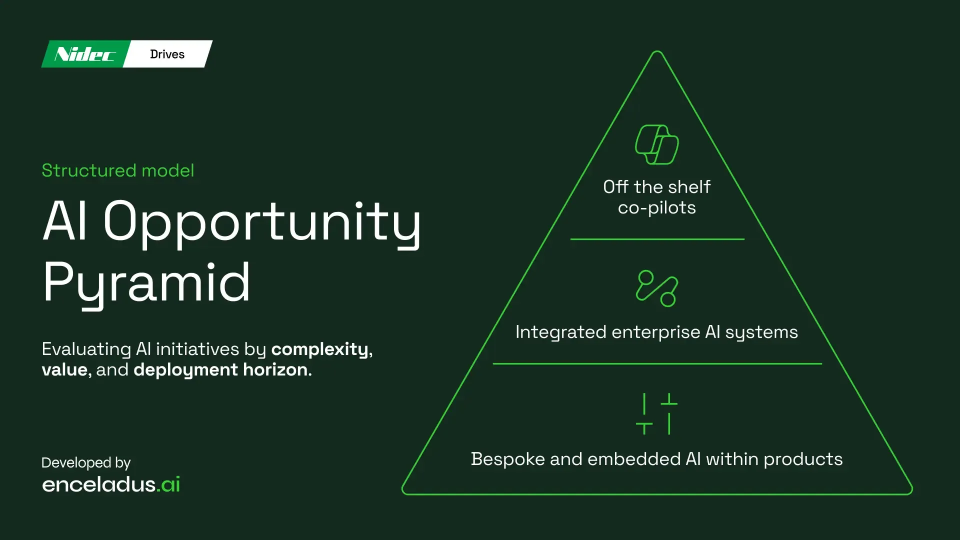
4. AI Opportunity Pyramid
We introduced a structured model to evaluate AI initiatives by complexity, value, and deployment horizon — from:
- Off-the-shelf copilots
- Integrated enterprise AI systems
- Bespoke and embedded AI within products
This supported prioritisation discussions grounded in commercial realism.
5. Governance, Ethics & Regulation
We mapped AI opportunities against:
- The EU AI Act risk-based framework
- Responsible AI principles (fairness, transparency, accountability, privacy, safety)
- Nidec's existing working groups and evaluation templates
Key outcome
Nidec's governance structure is already well-aligned — AI can be adopted without reinventing decision-making processes.
The Outcome
By the end of the session, Nidec's leadership team had:
A shared language and understanding of modern AI
Clarity on where AI is already delivering value in industrial settings
A grounded view of near-term opportunities vs longer-term bets
Confidence that AI adoption can proceed within existing governance
A clear next step: moving from awareness to cross-functional discovery and business case development
The session successfully shifted the conversation from "Should we use AI?" to "Where will AI create the most value — and what is the right approach for each opportunity?"