Converge Methodology artefact
The AI Opportunity Pyramid
Not every AI opportunity sits at the same distance from deployment, and treating them as though they do is the most common way AI programmes stall. The pyramid is a simple layered view of time-to-deploy that we put beside every opportunity's priority.
Four layers, by time to deploy
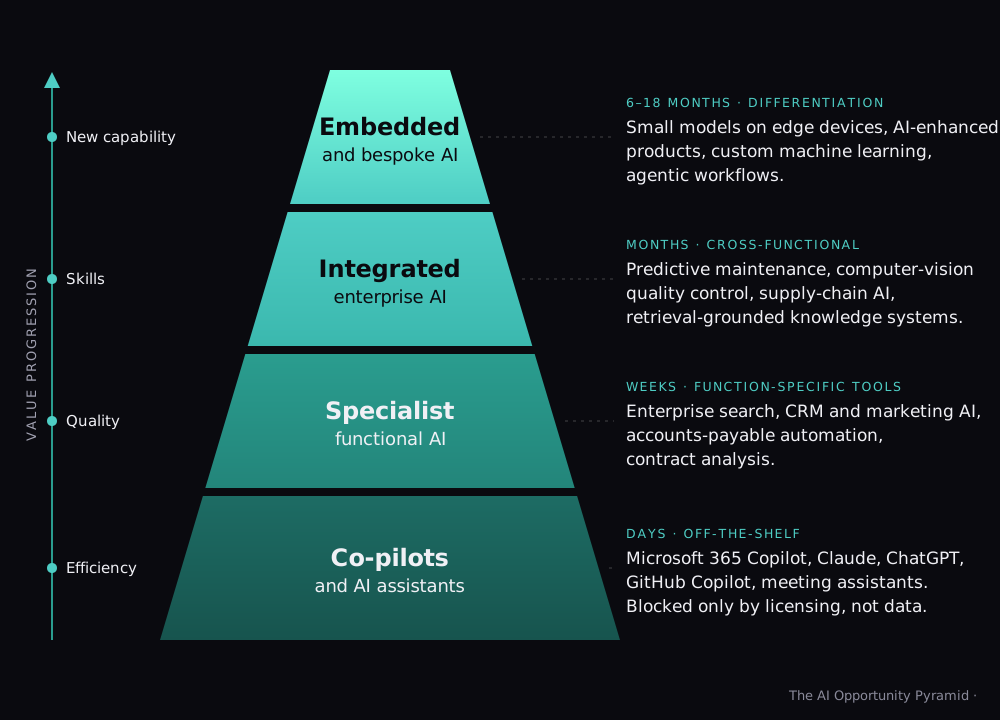
Four layers, four horizons
Co-pilots and AI assistants sit at the base: Microsoft 365 Copilot, Claude, ChatGPT, GitHub Copilot, meeting assistants. Off-the-shelf, days to deploy, and in most businesses blocked only by licensing decisions, not by data.
Specialist functional AI is the next layer: enterprise search, CRM and marketing AI, accounts-payable automation, contract analysis. Function-specific tools, weeks to deploy, usually a selection exercise rather than a build.
Integrated enterprise AI needs data and systems brought together first: predictive maintenance, computer-vision quality control, supply-chain AI, retrieval-grounded knowledge systems. Cross-functional, months to deploy, and where most of the value in an industrial business lives.
Embedded and bespoke AI is the apex: small models on edge devices, AI-enhanced products, custom machine learning, agentic workflows. Competitive differentiation, measured in quarters, and funded as research until the evidence supports a business case.
"Valuable" is not the same as "valuable and ready now"
In discovery, every opportunity is scored for priority: strategic fit, feasibility, complexity, cost, benefit, risk. The pyramid adds the dimension that scoring alone misses. Two opportunities can both be high priority and sit three layers apart, and the right action for each is completely different: switch one on this month, start a research programme for the other.
Reading the pyramid position alongside priority is what lets a leadership team build a first quarter that shows visible value from the base layers while the foundations for the upper layers are laid. It is also what stops the apex, which is where the excitement is, from consuming the budget before the business has data to feed it.
Value progresses up the pyramid, from efficiency at the base, through quality and skills, to new capability at the top. So does risk, cost and time. Most businesses should be working on three layers at once, at three different speeds.
Three questions for every opportunity
Which layer is this?
Decided by what has to exist before it can deliver: a licence, a selected product, integrated data, or research. Not by how impressive it sounds.
What is its data position?
Low dependency, in hand, siloed, partial or absent. An integrated- layer opportunity with absent data is a data-foundation project first, whatever its priority.
What is the adoption pathway?
Product-led, system-embedded, research-led or data-foundation. The layer suggests it; the pathway says what actually has to happen, and in what order.
About the pyramid
Where did the pyramid come from?
We developed it for leadership awareness sessions with industrial and publishing clients, where the recurring problem was that every AI idea was being discussed as if it could be switched on next quarter. It has since become the frame for every Converge Methodology programme.
Is the base layer really worth the attention?
It is usually the fastest value in the business, and the most frequently blocked. In our last full programme the two strongest quick wins were both base-layer opportunities held back only by an access restriction.
Can an opportunity move between layers?
Yes, downward as the market matures: capabilities that were bespoke two years ago now ship inside enterprise products. That is why the pyramid is reviewed, not fixed, and why the system-embedded pathway exists.
See where your opportunities sit
A leadership awareness session puts the pyramid to work on your own business in a day.