Blog

Insights

Practical thinking on putting AI to work.

  • Why we publish our method

    Every AI consultancy names a framework. Almost none shows one. We publish the Converge Methodology in full, with its artefacts, because a method you can inspect is one you can trust, and because the value is in the running of it, not the secret.

  • Who owns the AI you pay for?

    Code, evaluation sets, prompts, indexes, the data the system learned from: each is owned by someone, and the answer differs between a product, a platform and a build. What to ask so the system you pay for is yours.

  • Fixed price or day rate for AI work?

    Day rates reward time; fixed prices reward outcomes, provided the scope is real. Which to use for consultancy, for a build and for the running of a system, and the one condition that makes a fixed price safe for both sides.

  • What a good AI discovery report looks like

    The deliverable at the end of discovery is a document, so here is what a good one contains, section by section, and the questions to ask of a consultancy's sample before you commission one.

  • AI in retail: beyond the chatbot

    Retail was early to AI and most retailers still think of it as the customer-facing bot. The faster returns are elsewhere: product content, segmentation, service assistants grounded in the systems of record, and forecasting once the data is pooled.

  • AI for ecommerce agencies: where the hours go

    Support queues, content at scale, reporting, SEO and now AI search: an agency's time goes on workflows with a codebase or a data source behind them, which makes agencies unusually well placed for tailored AI. What we did with our own.

  • AI for publishers: online versus print workflows

    A magazine publisher's AI opportunities split cleanly in two: the digital platforms, where the work is data and personalisation, and the print-led workflows, where it is production and archive. Treating them as one programme fails both.

  • What "enterprise" actually means on an AI licence

    The word is on every pricing page and it means different things on each. The five things an enterprise AI tier should give you, and how to tell which ones a given tier actually does.

  • Claude Code for engineering teams: a practical setup

    Agentic coding tools change how software is built, but only when the project instructions, standards, review gates and budgets are right. The setup we use ourselves, and recommend to clients.

  • Custom GPTs and Claude skills for a sales team

    The difference between a licence and a tool people use is configuration: assistants set up for the recurring work in a function, with its templates, its tone and its rules built in. Six we configure for sales, and the pattern behind them.

  • Rolling out Copilot by role, not all at once

    A licence for everyone on day one produces a bill and a shrug. A rollout by role, with champions, measurement and enablement on each function's own tasks, produces a change in how people work. How to sequence it.

  • No-training licence terms: what to check before you sign

    The contractual commitment that your data is not used to train the model is what makes enterprise AI tools safe to open. What the commitment actually covers, where it does not apply, and the six things to confirm at contracting.

  • Human in the loop: where the threshold goes

    "Human in the loop" is a slogan until someone decides where the loop closes. The real design question is the threshold: how sure must the system be before it acts alone, and who decides that, on what evidence.

  • Evaluating an AI agent before you trust it

    An agent that cannot be measured is not ready for production. What an evaluation set is, how to build one with your own experts in a few hours, what to measure, and why it has to run on every change.

  • RAG, GraphRAG and when you need each

    Retrieval-augmented generation answers from passages that look like the question. GraphRAG adds the relationships between things. Which one a knowledge assistant needs depends on the questions people actually ask.

  • Four fields to add to every AI business case

    Most investment templates were written before AI. Four fields, risk category, data protection, human oversight and transparency, make governance part of every AI decision instead of a gate at the end.

  • ISO 42001 in plain English

    The AI management-system standard, explained without the jargon: what it asks for, who actually needs certification, and why a governed-access model gets most businesses most of the way there.

  • AI literacy is now a legal duty: what that means for your business

    Article 4 of the EU AI Act has applied since February 2025 and requires a sufficient level of AI literacy among staff who use AI systems. Who it covers, what "sufficient" means, and the training that meets it without a compliance programme.

  • Governed AI access: a model that works

    The alternative to blocking AI tools is not a free-for-all. It is five controls, all well established, that make enterprise AI safe to open and unlock the cheapest value in any AI programme.

  • From ideas to business cases: consolidating AI opportunities

    Two hundred ideas is not a submission list. Why ideas that share a capability are consolidated into single use cases, how "one licence, many benefits" changes the economics, and what a submittable use case contains.

  • Running a divergent AI workshop without the hype

    The first half of discovery is about breadth, not judgement: every idea, however small, captured with its pain and its current process. How we run the room so the people who know where the time goes actually say so.
  • The ten questions that score an AI use case

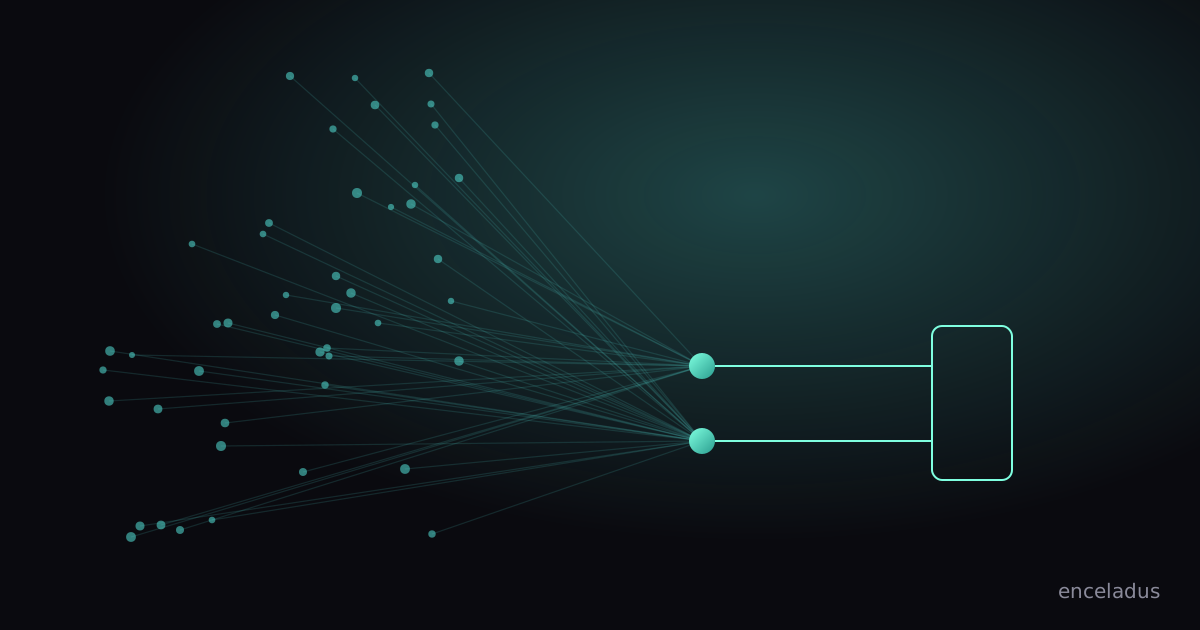
    Comparing AI ideas fairly needs one scale. These are the ten elements we score every idea on, what each one is really asking, and why the scores are offered as a straw man for the business to correct.

  • What a leadership AI awareness session should cover

    Not a tour of tools. A good executive AI session gives a leadership team a shared vocabulary, a view of the competitive baseline, a frame for placing opportunities, and the governance map, in a day. Here is the agenda.

  • Why data readiness, not technology, decides your AI roadmap

    The tools for most AI opportunities already exist. What decides whether an opportunity can be delivered, and when, is whether the data it depends on exists in a usable form. How we assess it, and why it means sequencing by readiness rather than enthusiasm.

  • Four levels of AI: copilot, assistant, agent, agentic system

    The words are used interchangeably, which is why AI conversations go in circles. One scenario shown at four levels makes the shift from AI that assists people to AI that owns outcomes concrete, and tells you which level each use case should reach.

  • Why blocking ChatGPT at work makes the data risk worse

    A blanket block on AI tools is the costliest governance decision we see. It does not stop AI use; it moves it to personal accounts the business cannot see, and it forfeits the cheapest value in any AI programme.

  • The EU AI Act for UK businesses: a guide

    A long-form guide: who is in scope, the four risk categories with examples, every date that matters, the AI literacy duty already in force, what each category requires, the UK position, and a twelve-step plan a business can run without a compliance programme.