An AI discovery programme is a structured way of finding out where AI creates value in a specific business and deciding where to start. Done well, it takes eight to twelve weeks, involves the people who do the work rather than only the people who manage it, and ends with a small set of use cases the board can fund and a first quarter the business can start on. Done badly, it ends with a hundred sticky notes and a vendor demo. This is how we run it.
Start with vocabulary, not ideas
Discovery that begins with “what could we do with AI?” produces ideas shaped by whatever each participant last read. So the first phase is an awareness session for the leadership team and then the functional groups: what the technology is and is not, the four levels of AI from copilot to agentic system, and the Opportunity Pyramid that places opportunities by time to deploy. By the time anyone is asked for ideas, everyone in the room means the same thing by “agent” and knows that an on-device model and a meeting summariser are not the same kind of project.
Open the field as wide as it goes
The divergent workshops are organised by function. In our most recent full programme, for a global industrial manufacturer, that meant R&D, manufacturing, procurement and supply chain, sales and service, and marketing, with product management and IT represented inside each session rather than treated separately. Six to fifteen people per workshop, two to three hours, facilitated rather than presented.
The purpose is breadth, not judgement. Every idea is logged with four things: the pain or opportunity in the participant’s own words, how the work is done today, what the AI would do, and who would benefit. Nothing is filtered for feasibility at the point of capture, because the person raising an idea is rarely the person who knows whether the data exists to support it, and filtering early loses the ideas that matter most.
Five sessions produced 250 ideas. They ranged from embedding AI inside the product to generating test scripts to triaging an inbox.
Pre-cluster and pre-score, then let the room correct you
Between the divergent and convergent sessions we cluster each function’s ideas into related groups and score every cluster against the same ten elements: priority, strategic fit, technical feasibility, complexity, estimated cost, estimated benefit, risks, data position, vendor options and recommendation. The scoring is deliberately offered as a straw man, an “Aunt Sally” for the room to knock down.
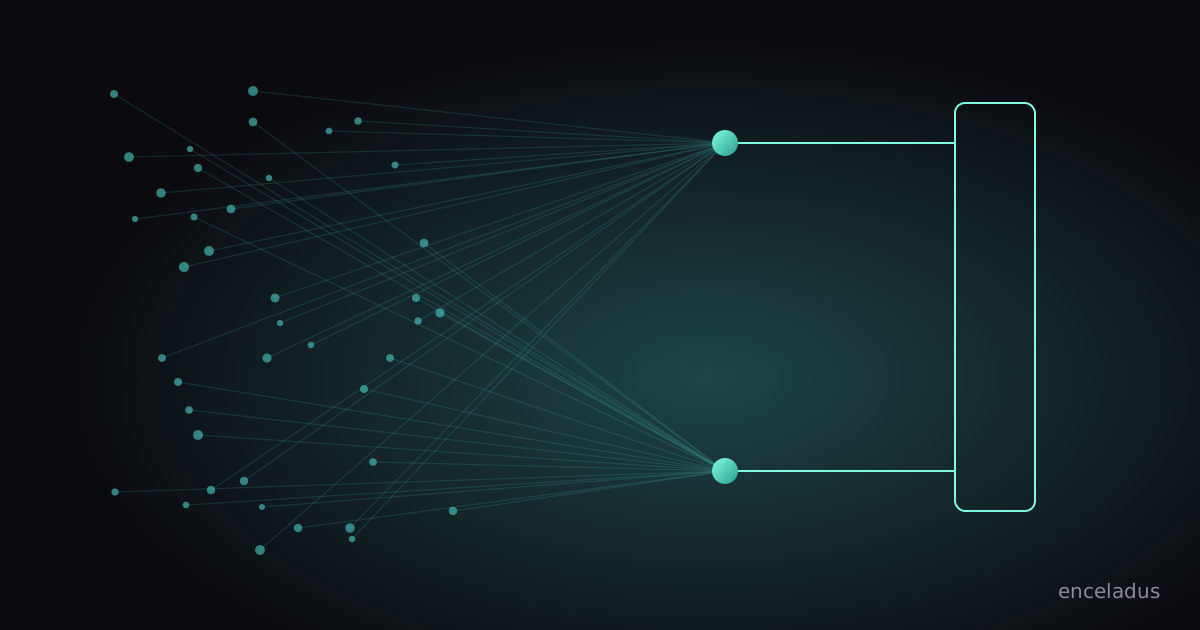
This step is the one most programmes skip, and it is the one that makes the output credible. A blank scoring sheet produces polite, uncalibrated scores. A straw man produces argument, and argument produces scores the business actually believes, because it set them. In the convergent workshops the clusters are challenged, corrected and force-ranked by the people who raised the ideas, and the cross-business themes, the capabilities that recurred in every function, are shared with every group.
Consolidate before you submit
Two hundred and fifty ideas is not a submission list. Many call on the same capability, the same language-model licence, the same knowledge platform, and differ only in who uses it and for what. Submitting them individually understates their value and overwhelms whatever investment process the business runs.
So ideas sharing a capability are consolidated into single use cases. In the programme above, 250 ideas became 27: eleven cross-business themes and sixteen function-specific candidates. Each is written in the client’s own assessment format, with its problem, what it consolidates, the scorecard, an adoption pathway, its pyramid layer and candidate vendors, so it enters the investment process without rework. Every underlying idea stays recorded and traceable beneath it.
Sequence by readiness, not enthusiasm
The roadmap groups the use cases by how ready they are, not by how much the business wants them:
| Group | What it means | Typical examples |
|---|---|---|
| Ready now | High value, low complexity, data in hand or blocked only by an access decision | Productivity assistant, content tooling, data-in-hand proofs of value |
| Nearly ready | High value, needs data preparation or coordination first | Knowledge platform, master-data foundation, in-flight customer-facing work |
| Strategic | High value, data-gated and complex, phased through bounded pilots | Forecasting and inventory, factory and energy optimisation, visual inspection |
| Research | Highest differentiation, longest horizon, funded as research until the evidence exists | Embedded and on-device AI, design automation, digital twins |
Underneath all four runs the data foundation. The single most consistent finding of every programme is that data, not technology, is the constraint; in this one, only about a third of the ideas had data ready today, and the themes with the most appetite were often the least ready.
End with a first quarter
A roadmap nobody starts is a document. Every programme ends with a recommended first quarter: the governance decision that unlocks the rest (in this case, replacing a blanket block on AI tools with governed, sanctioned access), two or three switch-on wins, two or three proofs of value on data the business already holds, and the foundations started in parallel. Visible value from day one while the ground for the larger prizes is laid.
What it needs from you
Time from the people who do the work: roughly three hours each, twice. A leadership team willing to be told that the exciting ideas are not the ready ones. And an investment process the use cases can enter, which almost every business of any size already has.
The method is published in full on our approach page, with the artefacts. The service is described under AI discovery workshops.