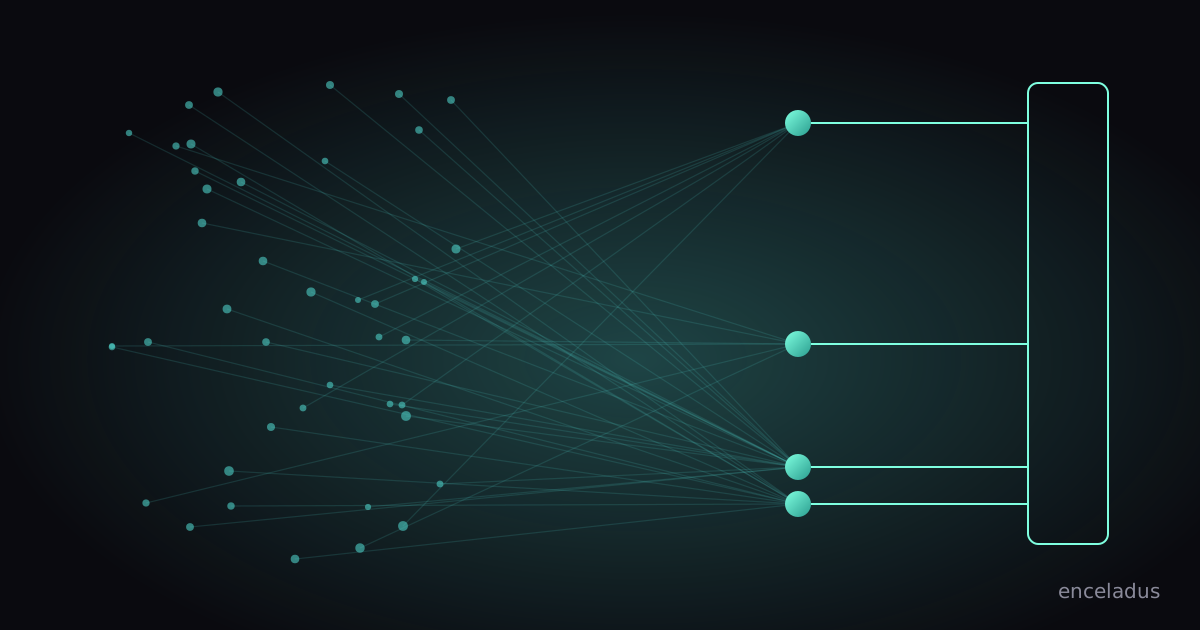
The divergent workshop is where AI discovery either works or quietly fails. Its purpose is breadth, not judgement: to surface every idea for where AI might help, from the people who do the work, without filtering for feasibility at the point of capture. Get it right and you have the raw material for a roadmap the business will act on. Get it wrong, usually by letting the loudest person or the latest vendor shape the list, and you have a brainstorm.
Who is in the room
One workshop per function: R&D, manufacturing, procurement and supply chain, sales and service, marketing, or the publishing, retail and agency equivalents. Six to fifteen people who do the work, with product management and IT represented inside the session rather than treated as separate functions. Not the leadership team; they have had their own session, and their presence in a functional workshop changes what people say.
What is captured for every idea
Four things, in the participant’s own words:
- The pain or opportunity. “Inboxes are triaged by eye so important emails get missed.” “Meeting minutes are taken by hand.”
- How the work is done today. The current process, however manual.
- What the AI would do. The capability it would call on, as the participant imagines it.
- Who benefits. The function, the role, the customer.
Each idea is also tagged with its layer on the Opportunity Pyramid as it is raised, which is the only judgement applied in the room, and it is a sorting judgement, not a filtering one.
Keeping judgement out
The facilitator’s job is to stop three things. First, feasibility arguments: “that will never work because of the data” is a convergent-workshop conversation, and raising it now loses the idea and the next three. Second, vendor framing: “we should buy X” is an answer, not an idea; the facilitator asks what the pain is that X would address and captures that. Third, self-censoring: the ideas people hesitate over, the embarrassing manual workaround, the spreadsheet everyone depends on and nobody admits to, are usually the most valuable, because they describe the real process.
Why the small ideas matter
In every programme, the ambitious ideas arrive first: embed AI in the product, forecast the whole supply chain, build a digital twin. The small ones come after an hour, once people trust that nothing is being judged: generate the slide pack from the technical data, draft the purchase order, check the documentation for consistency. The ambitious ideas are usually data-gated and quarters away. The small ones consolidate, across functions, into the quick wins that start the first quarter and earn the programme its budget. In our most recent full programme, twenty-six separate small ideas from five functions became one productivity use case that was ready to switch on.
What comes out
Fifty to sixty ideas per function is typical. Five functions produced 250. Every one is logged in a workbook with its capture and its pyramid layer, which is the record the convergent workshop then clusters, scores and force-ranks, and which the final report’s index points back to, so any decision can be traced to the room it came from.
What it needs from the business
Three hours of the right people’s time, a facilitator who is not their manager, and a leadership team that has already had its awareness session, so the vocabulary in the room is shared and the question is “where?” rather than “whether?”.
The workshops are described under AI discovery workshops; the convergent half is covered in the ten questions that score an AI use case.